
About PALSNet
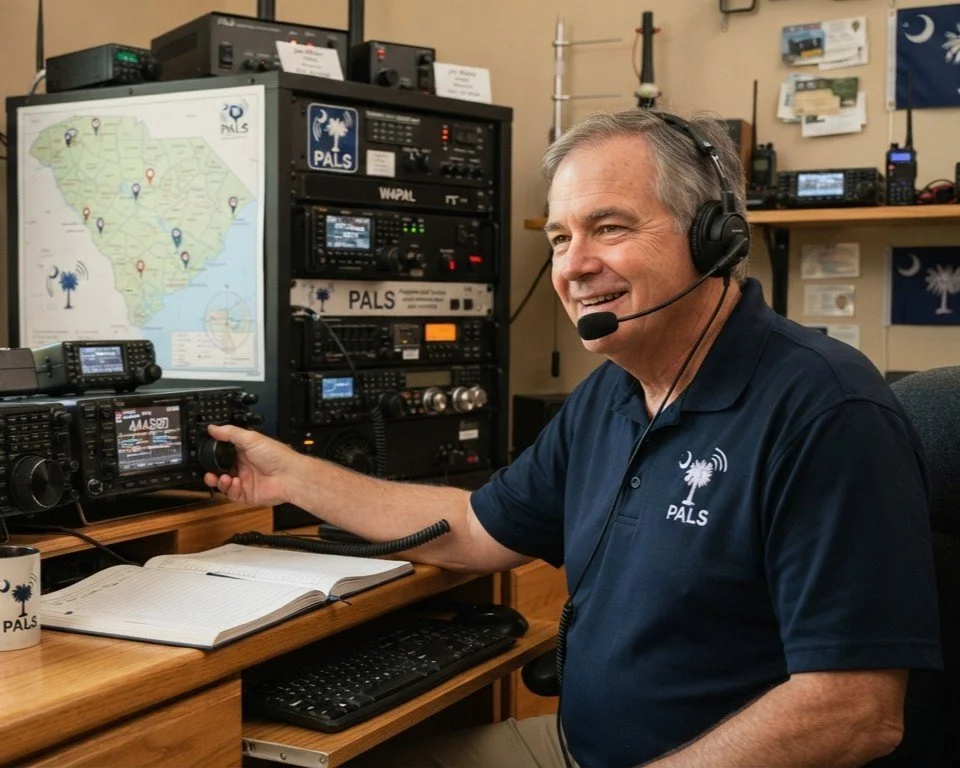
The Palmetto Amateur Linked System Network (PALSNet) serves as both a wide-area repeater infrastructure for daily amateur radio use and a vital emergency resource for the State of South Carolina.
Our History & Mission
PALSNet was originally conceived by three dedicated amateur radio operators: Jack Pegues (W4APE) of Cheraw, Dr. Jack Wood (KI4CB) of Pawley’s Island, and Abb Brown (KG4AQH) of Kingstree.
The network was specifically planned as a resilient Emergency Support System in the wake of devastating regional disasters, including the 1984 F4 tornadoes in Chesterfield and Marlboro Counties, and Hurricane Hugo in 1989. Today, the PALSNet Association is an officially ARRL Affiliated Club operating with full liability insurance and active IRS 501(c)(3) non-profit status.
System Features & Capabilities
PALSNet is engineered for extreme reliability and continuous operation under harsh emergency conditions:
Commercial-Grade Hardware: Every site features a GE MASTR II 100-watt continuous duty commercial repeater configured to run safely at 70 watts.
Emergency Power: Each independent repeater site is fully equipped with auxiliary emergency backup power.
Decentralized Fallback: If a widespread system failure occurs, any repeater can be disconnected from the central link network to function as a standalone local asset.
National Weather Service Integration: The Florence Hub features an integrated NWS Weather Warning receiver that can immediately broadcast critical weather watches and warnings across the entire linked system.
Network Operations & Community Impact
The defining feature of PALSNet is its linked infrastructure: any signal transmitted into one network repeater is automatically retransmitted across all other repeaters in the system simultaneously.
Daily Traffic Net: We host a public Traffic Net every night at 9:30 PM Local Time to practice formal message handling and test system readiness.
Skywarn Activation: PALSNet regularly supports Skywarn emergency exercises. During live severe weather activations, the Net Control Station (NCS) is positioned safely outside the affected hazard area to maintain uninterrupted coordination.
Inter-Agency Backup Path: Our network acts as a crucial, secondary communication path linking the major National Weather Service (NWS) offices in Wilmington, Charleston, and Columbia.
System Status Audio Tones
When operating on PALSNet, your radio will broadcast helpful status "courtesy tones" to let you know how your signal is traveling:
One Beep: Indicates that your local repeater has been taken off the main network link and is operating independently.
Two Beeps: Indicates the incoming signal you are hearing is reaching you from elsewhere on the linked network.
Three Beeps: Confirms your signal is successfully entering the local repeater and successfully broadcasting across the wider link network.
One Long Beep: Replaces the standard three-beep signal to alert operators that the local repeater is currently running on emergency standby power.
Would you like me to add a technical specs section listing the specific repeater frequencies and locations, or should we draft a "How to Join/Support" section for prospective club members?